 |
RECENT ALBUM REVIEWS |
|
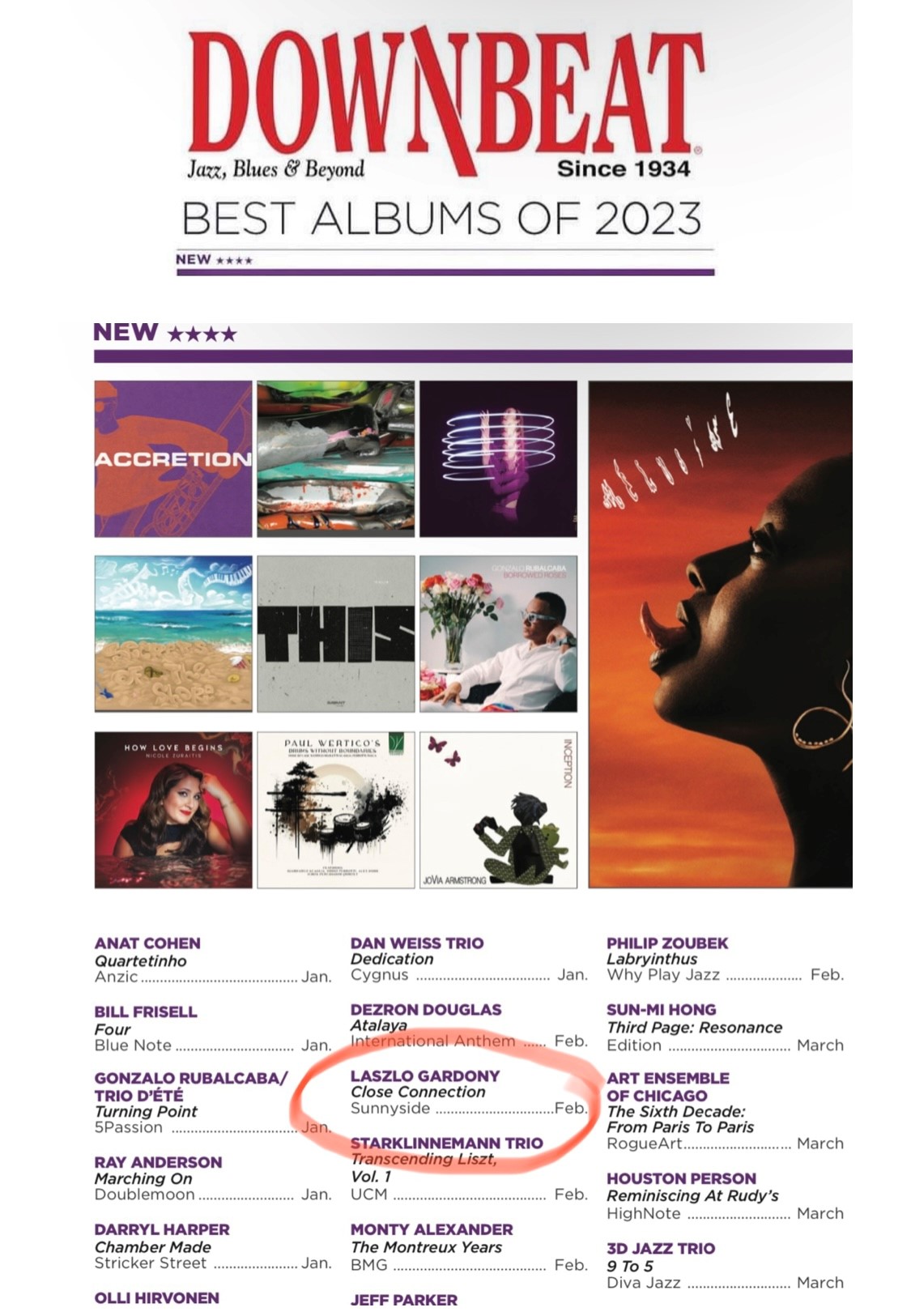
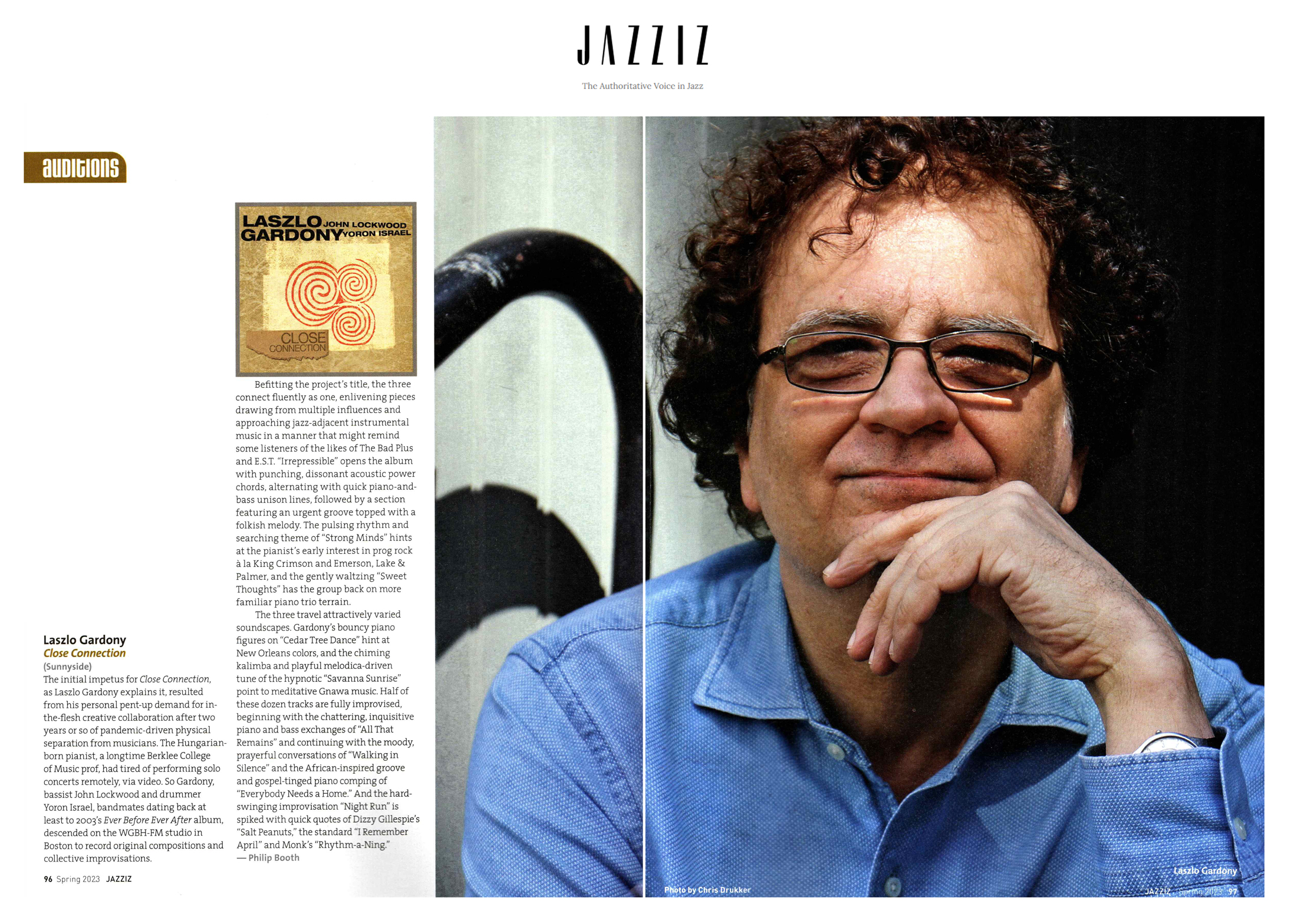
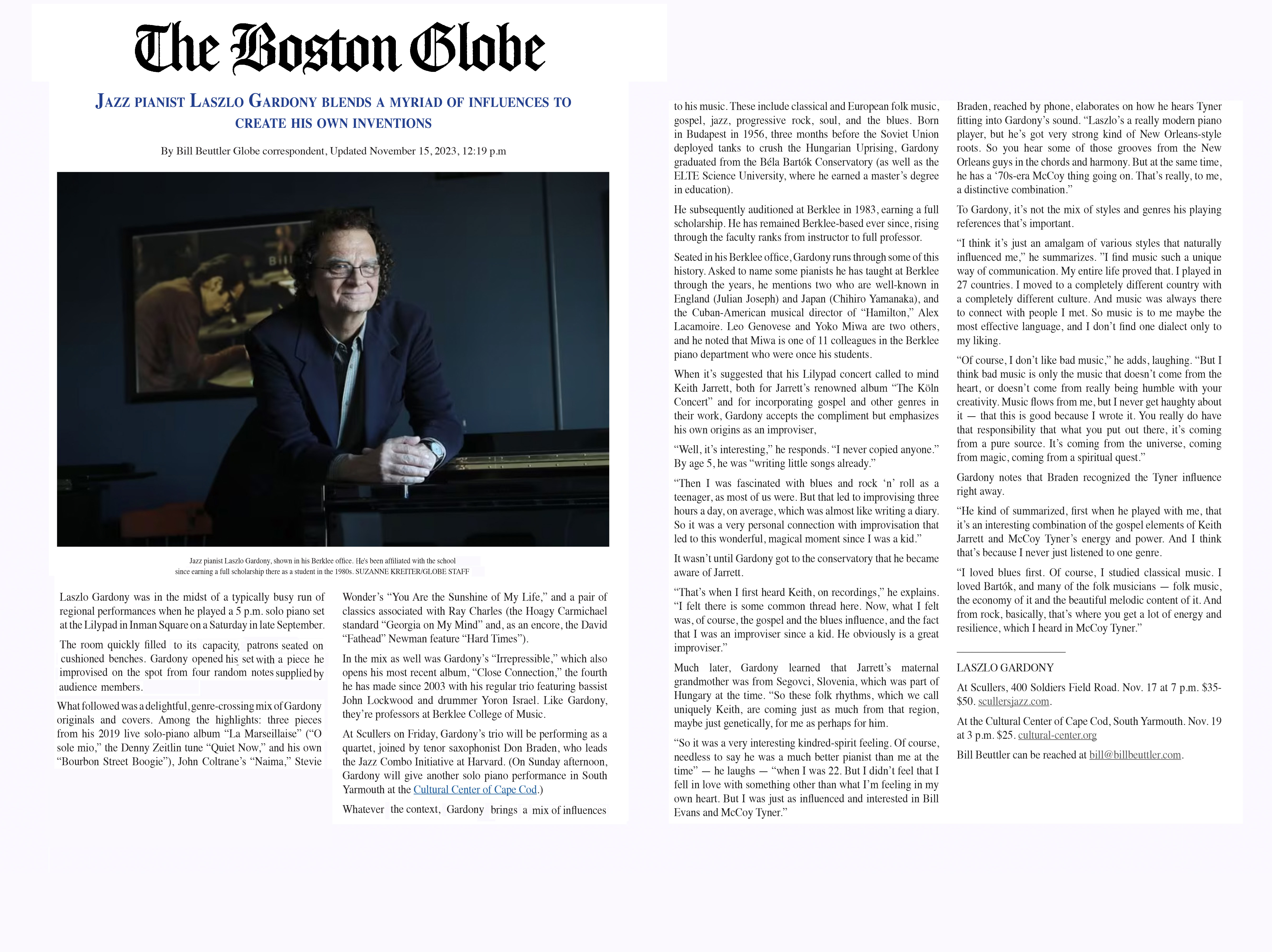
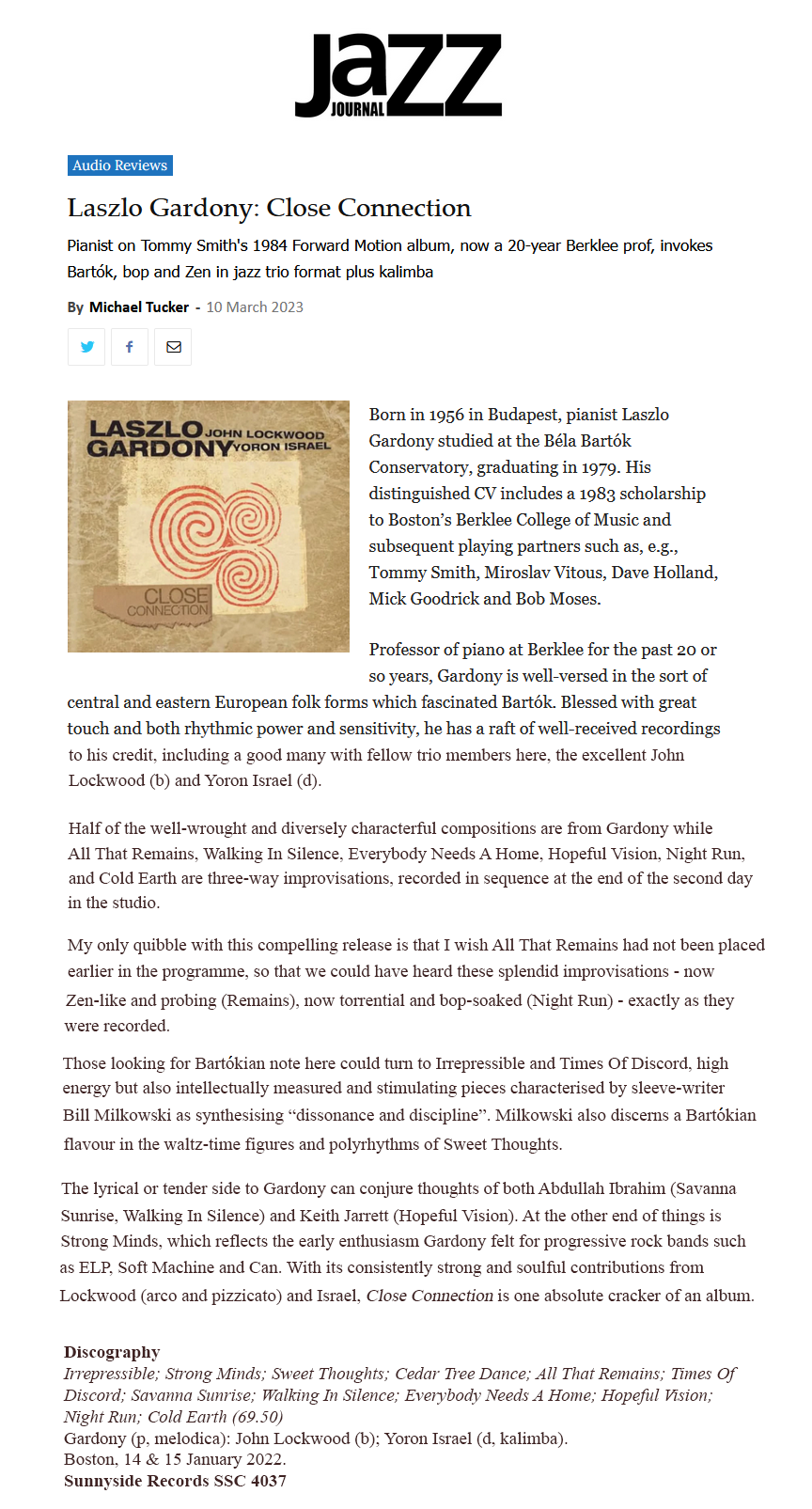
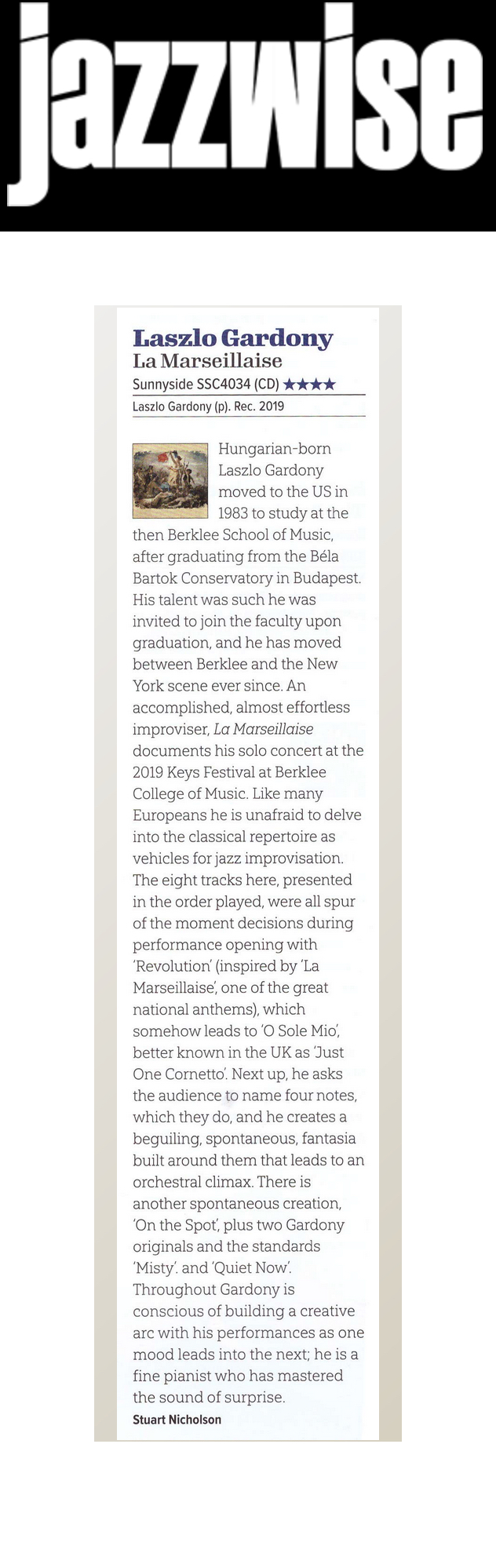
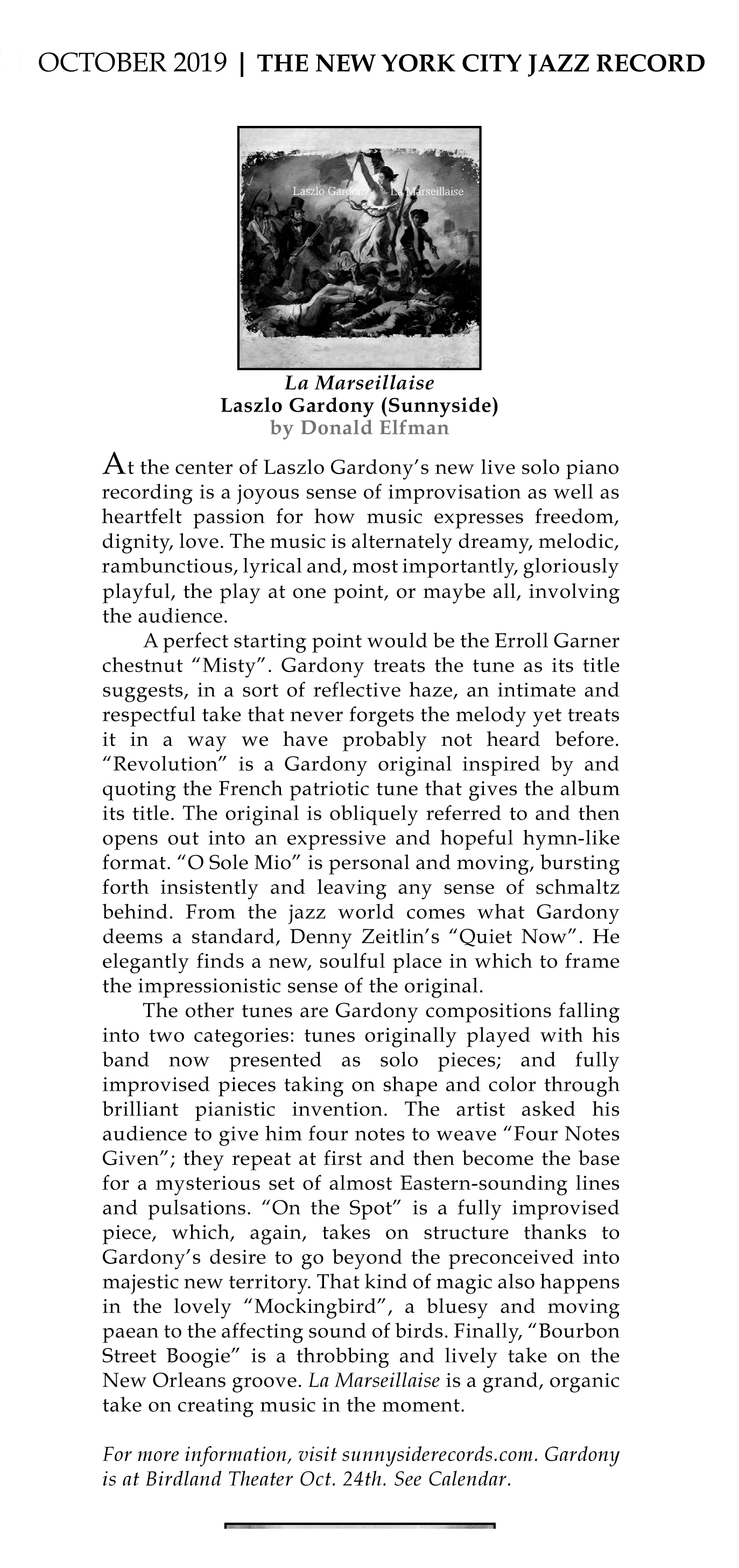
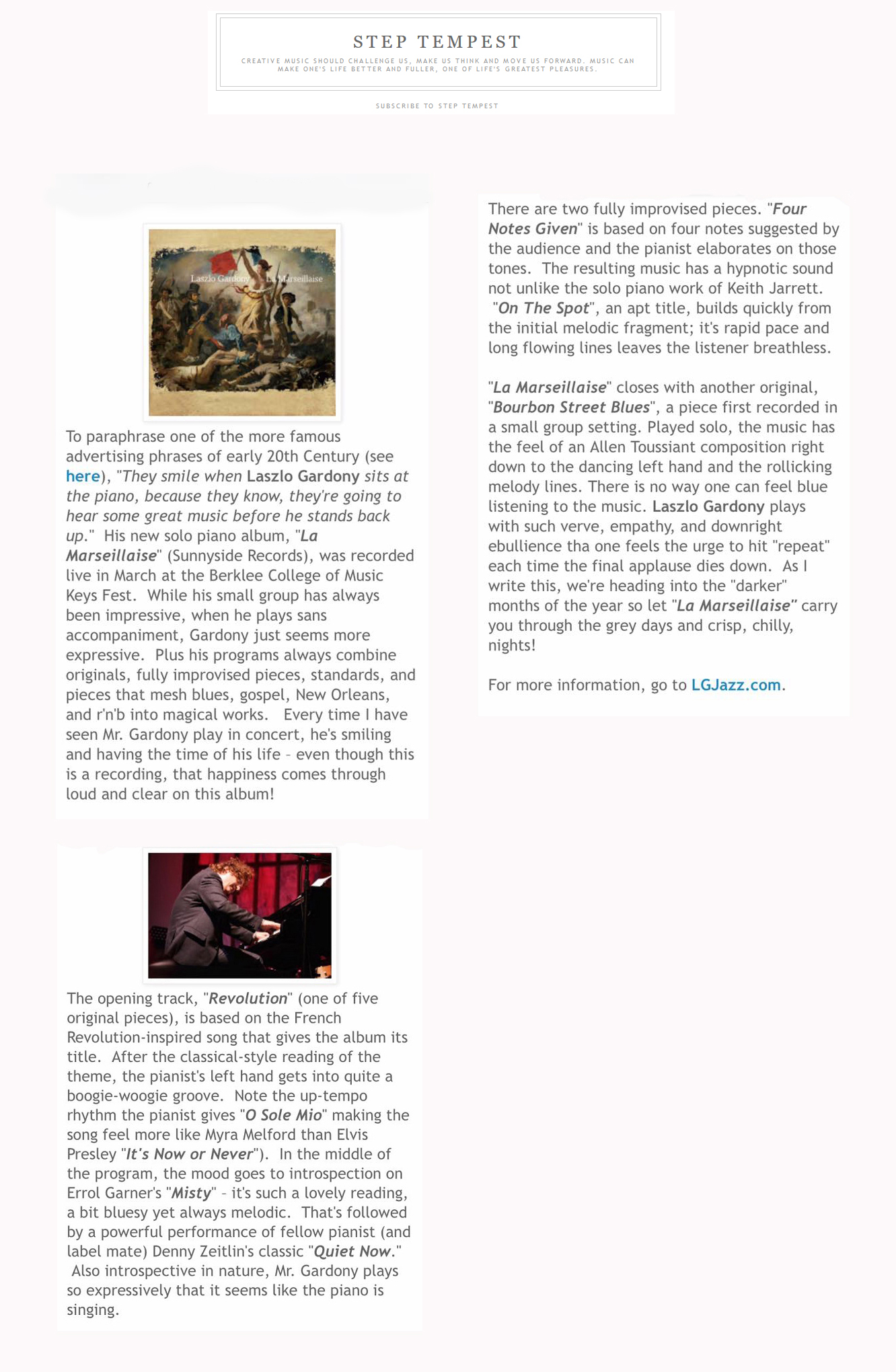
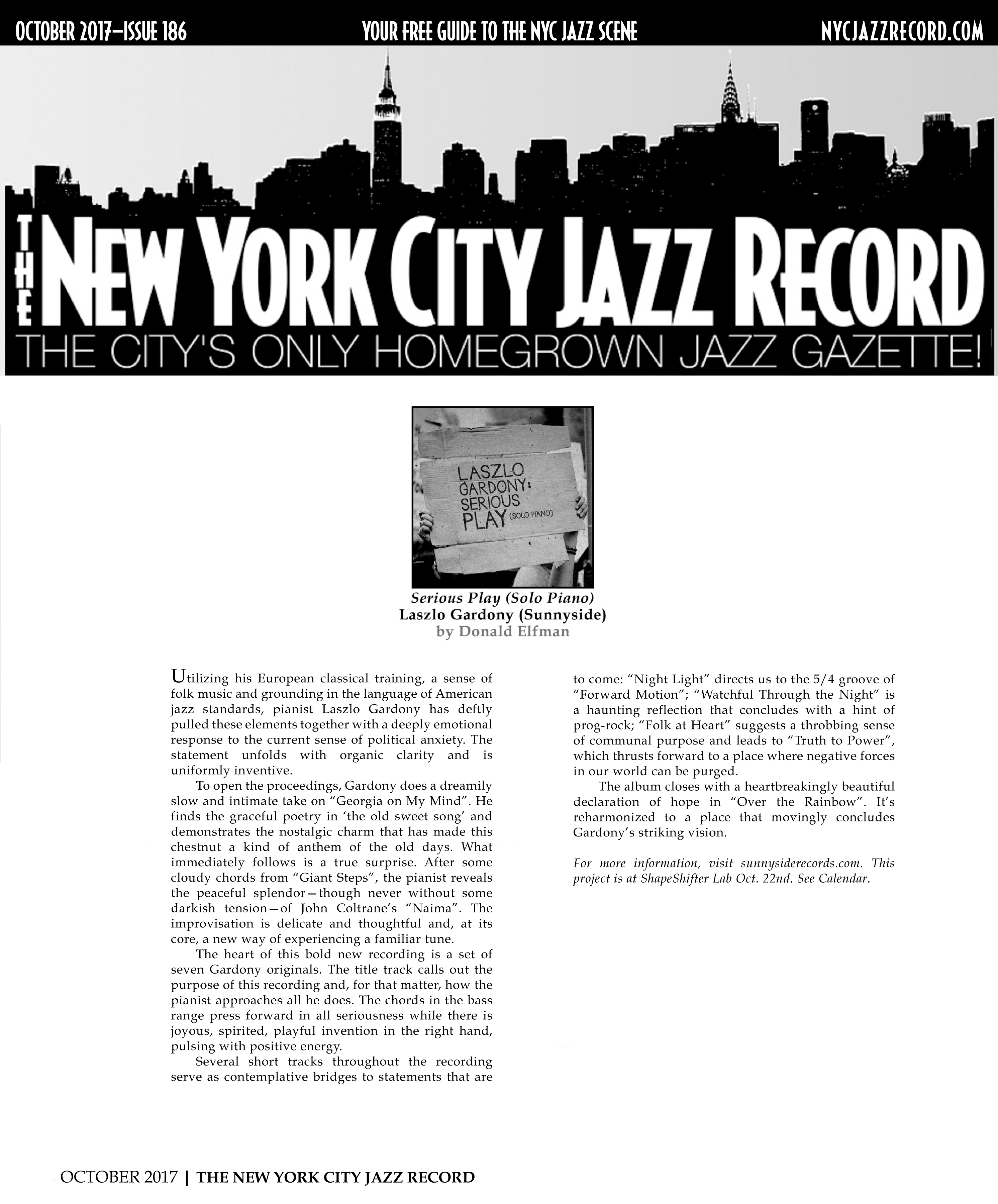
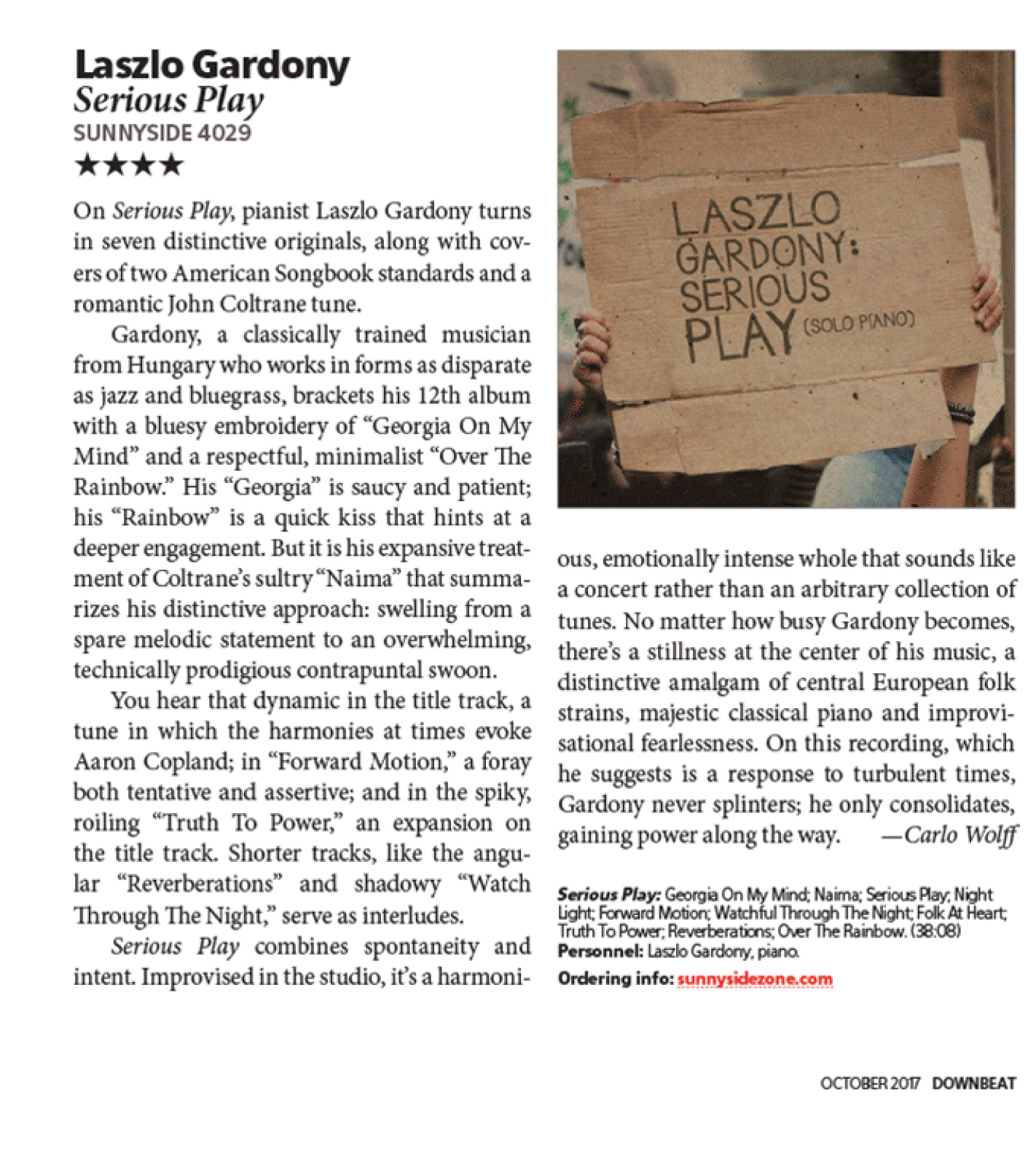
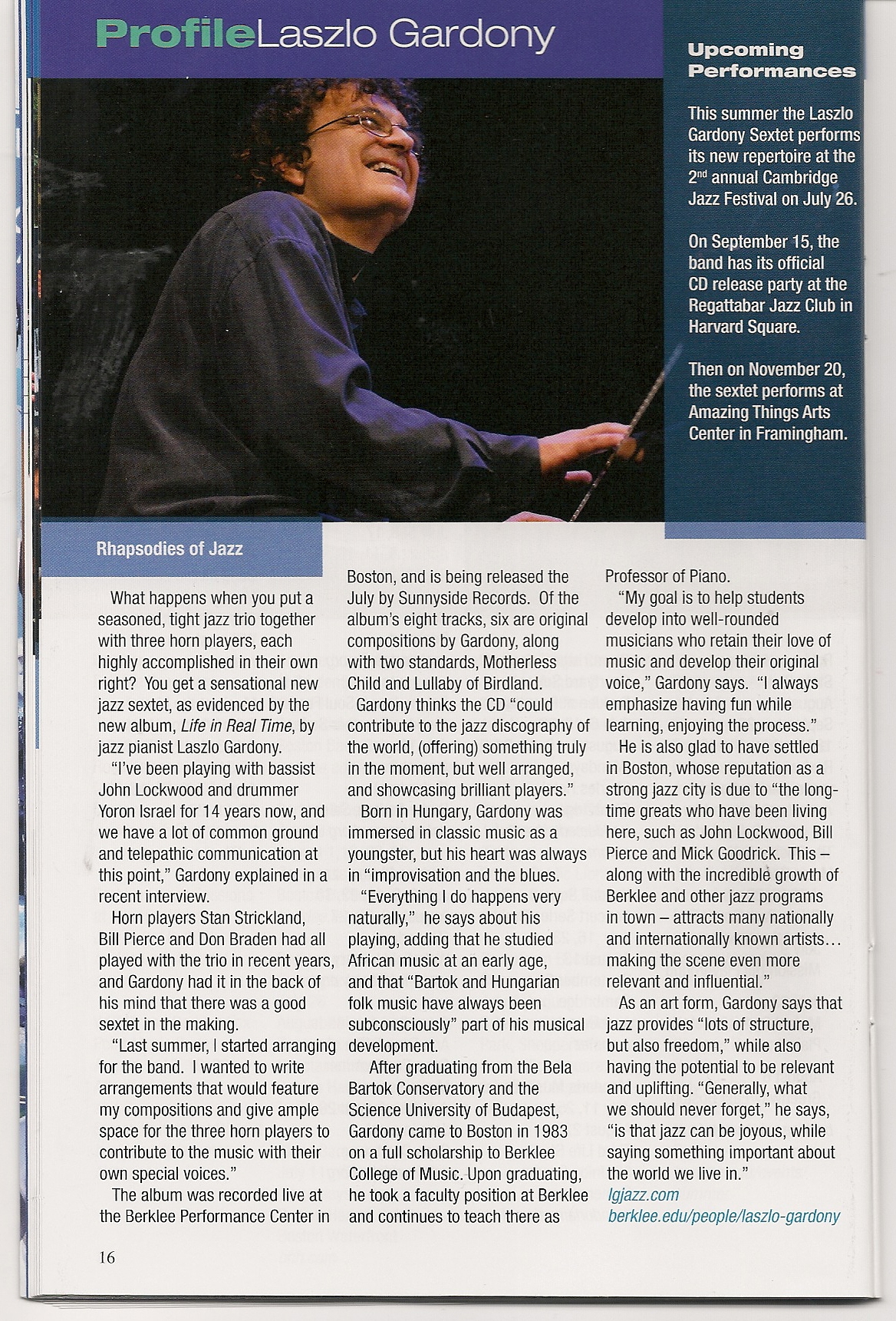
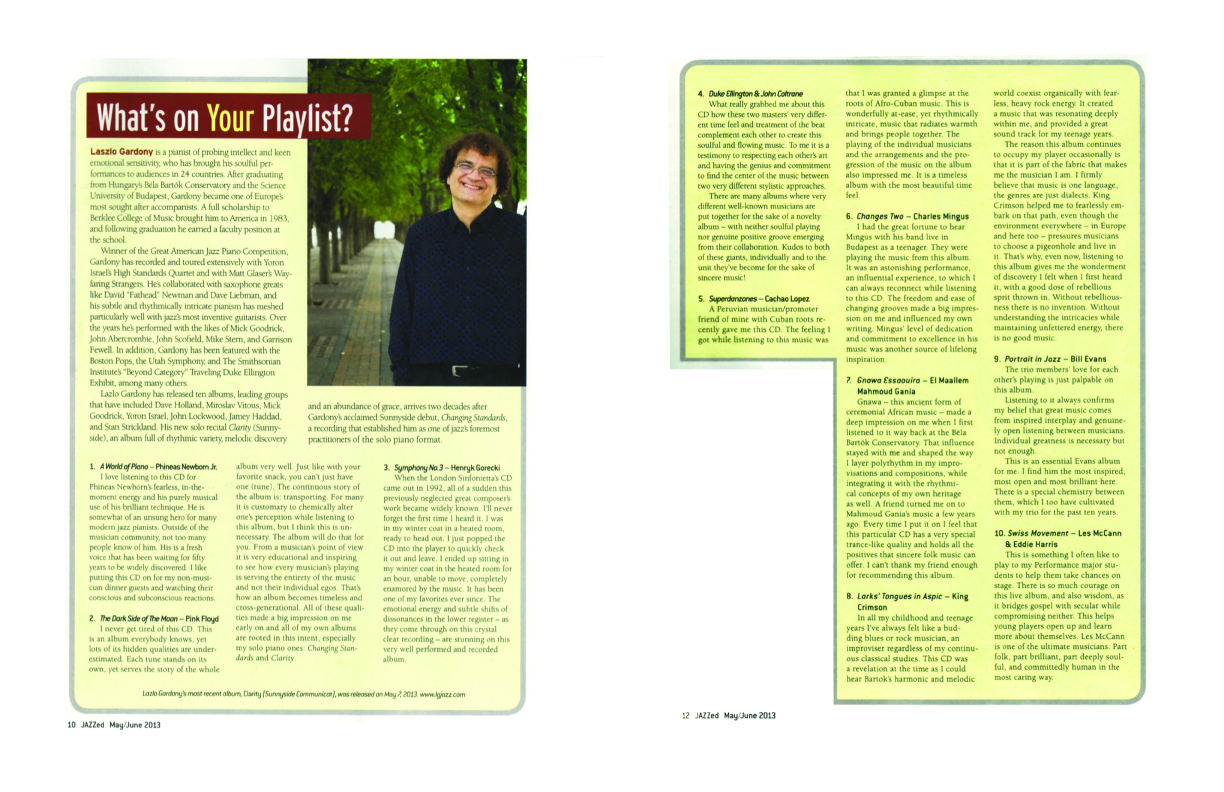
DOWN BEAT MAGAZINE ~ BEST ALBUMS OF 2023 JAZZIZ MAGAZINE ~ Philip Booth's feature about "Close Connection" (Sunnyside Records) March, 2023 THE BOSTON GLOBE ~ Feature article about Laszlo Gardony - by Bill Beuttler - November, 2023 ALL ABOUT JAZZ ~ Dan Bilawsky's review of "Close Connection" (Sunnyside Records) June, 2023 JAZZ ESPRESSO, ITALY ~ Interview with Ivano Rossato March, 2023 JAZZ JOURNAL, U.K. ~ Michael Tucker's review of "Close Connection" (Sunnyside Records) March, 2023 MONARCH MAGAZINE ~ Review of "Close Connection" (Sunnyside Records) February, 2023 ReMUSIC HI-FI, HI-END, HI-TECH AUDIO MAGAZINE (ITALY) ~ Riccardo Talamazzi's review of "Close Connection" February, 2023 MAKING A SCENE-INDEPENDENT MUSIC MAGAZINE Jim Hynes' "Top 30 Jazz Releases for 2022" List "Close Connection" December, 2022 MAKING A SCENE-INDEPENDENT MUSIC MAGAZINE Jim Hynes' review of "Close Connection" December, 2022 ARTS FUSE MAGAZINE ~ Michael Ullman's Concert Review - David Friend Recital Hall, Berklee, Boston - January, 2023 ARTS FUSE MAGAZINE ~ Jon Garelick's album review & concert pick "Close Connection" (Sunnyside Records) January, 2023 MUSIC FRAMES (NETHERLANDS) ~ Mattie Poels' review of "Close Connection" (Sunnyside Records) January, 2023 DOWN BEAT ~ Brian Morton's four-star review of "Close Connection" (Sunnyside Records) January, 2023 JAZZIZ EDITORS' CHOICE PLAYLIST DEC. 30 2022 [10-album list on Spotify] ~ "Close Connection" (Sunnyside Records) POP MATTERS ~ John Garratt's review of "Close Connection" December, 2022 JAZZIZ TEN ALBUMS YOU NEED TO KNOW, DECEMBER 2022 EDITION ~ "Close Connection" (Sunnyside Records) MONARCH MAGAZINE'S JAZZ WINTER 2023 RECOMMENDATIONS ~ "Close Connection" (Sunnyside Records) NEW YORK CITY JAZZ RECORD ~Pierre Giroux's review of "Close Connection" (Sunnyside Records) December, 2022 STEP TEMPEST ~ Richard Kamins' review of "Close Connection" December, 2022 JAZZWISE, UK Stuart Nicholson's review of "La Marseillaise" March, 2020 NEW YORK CITY JAZZ RECORD Donald Elfman's review of "La Marseillaise" October, 2019 BOSTON GLOBE "Serious Play" : TOP 10 JAZZ CDs of 2017 PATRIOT LEDGER "La Marseillaise" : BEST JAZZ OF 2019 ARTS FUSE by Michael Ullman | "Serious Play" : TOP 10 JAZZ CDs of 2017 STEP TEMPEST Richard Kamins's review of "La Marseillaise" October, 2019 ARTS FUSE Michael Ullman's review of "La Marseillaise" October, 2019 NEW YORK CITY JAZZ RECORD Donald Elfman's review of "Serious Play" October, 2017 JAZZ JOURNAL Michael Tucker's review of "Serious Play" October, 2017 DOWN BEAT Carlo Wolff's review of "Serious Play" October, 2017 ALL ABOUT JAZZ Dan Bilawsky's review of "Serious Play" July 3, 2017 BOSTON CONCERT REVIEWS Laszlo Gardony Sextet at the 2016 Beantown Jazz Festival by Nelson Brill BOSTON GLOBE "Life In Real Time" : TOP 10 JAZZ CDs of 2015 DOWN BEAT CD Review "Life In Real Time" (Sunnyside) Laszlo Gardony Sextet w/ Bill Pierce, Don Braden | by Brian Zimmermman July 2015 ARTS FUSE Concert review: Gardony Quartet @ Regattabar | by Michael Ullmann Jan 2015 MASS JAZZ MAGAZINE Profile: Laszlo Gardony | by Michael Quinlin July 2015 DOWN BEAT Review of a solo piano concert in NYC written by Bill Milkowski Sep 2014 BOSTON GLOBE Feature article written by Jeremy D. Goodwin February, 2014 JAZZ TIMES Bill Beuttler's review of "Clarity" July, 2013 LOS ANGELES TIMES Chris Barton's review of "Clarity" July, 2013 POP MATTERS Steve Horowitz' review of "Clarity" June, 2013 WNPR feature article by Owen McNally Feb 2015 BOSTON GLOBE Jon Garelick's review of "Clarity" April, 2013 JAZZ JOURNAL (UNITED KINGDOM) Fred Grand's review of "Clarity" September, 2013 ALL ABOUT JAZZ Mark Corroto's review of "Clarity" May, 2013 ALL ABOUT JAZZ Hrayr Attarian's review of "Clarity" May, 2013 ALL ABOUT JAZZ Franz A. Matzner's review of "Clarity" May, 2013 JAZZIZ Review of "Clarity" May, 2013 STEP TEMPEST Richard Kamins' review of "Clarity" May, 2013 NEW YORK CITY JAZZ RECORD George Kanzler's review of "Clarity" September, 2013 JAZZ ED MAGAZINE "What's On Your Playlist?" article by Laszlo Gardony May/June, 2013 ALL ABOUT JAZZ, ITALY Neri Pollastri's review of "Clarity" Feb, 2014 BIRD IS THE WORM Dave Sumner's review of "Clarity" July, 2013 IMPROVIJAZZATION NATION (HAWAII) Rotcod Zzaj's review of "Clarity" Sept, 2013 TOMAJAZZ (SPAIN) Carlos Lara's review of "Clarity" September, 2013 BEBOP SPOKEN HERE Steve H's review of "Clarity" May, 2013 JAZZMOSTLY.COM Review of "Clarity" April, 2013 JAZZ 'N' MORE (SWITZERLAND) Jurg Solothurnmann's review of "Clarity" Sept, 2013
Laszlo Gardony : Signature Time (Sunnyside) Without much fanfare the Hungarian-born, Boston-based pianist and educator Laszlo Gardony has gone about his business of churning out one compelling, swinging CD after another over the course of 25 years. His fifth for the Sunnyside label and ninth overall again features his longstanding rhythm tandem of bassist John Lockwood and drummer Yoron Israel. Together they celebrate the birthplace of culture and sound with a program of African-based musical styles. From his mesmerizing 13-bar original "On African Land" to an exuberant, gospel-tinged take on the Beatles' "Lady Madonna" (with nods to Les McCann along the way) and the Professor Longhair-inspired "Bourbon Street Boogie," featuring bar-walking contributions from guest tenor saxophonist Stan Strickland, everything here can be traced back to the African musical heritage. A clever arranger and thoughtful composer - his reflective "Under the Sky," featuring Israel overdubbing on vibraphone, is a highlight - Gardony is also a formidable soloist who lives in the moment. And he often demonstrates, as on the elegant, samba-flavored "With You at the Bridge," a willingness to detour off the expected path with some improvisational daring that follows its own course. His mastery of the postbop idiom is also represented on a swinging rendition of Billy Strayhorn's "Johnny Come Lately," featuring Strickland on tenor and Lockwood stretching out with an exceptional, woody-toned bass solo. Perhaps the most surprising and original track here is "Spirit Dance," which evolves gradually with Strickland's wafting wordless vocals providing a shaman's touch. It's just one more engaging surprise on a diverse album full of them.
Laszlo Gardony : Signature Time (Sunnyside) Laszlo Gardony, the European and Berklee College-trained virtuoso pianist and composer, loves to play with unusual time signatures and advanced harmonies as he hammers out thickly textured original pieces or sculpts dramatic reconfigurations of standards that tap into jazz, funk, gospel, rock, hip-hop, world music and contemporary classical music. Although the Hungarian-born musician and graduate of Bela Bartok Conservatory in his native Budapest gleefully stretches rhythm, harmony and melody into all sorts of new shapes and colors, his music is pleasantly accessible. For all his training in classical music, his music is celebratory, toe-tapping and danceable. Gardony, who can sound like a one-man band thanks to his orchestral approach to the piano, performs in a spare duo format Sept. 10 at 8 p.m. at the Buttonwood Tree Performing Arts and Cultural Center, 605 Main St., Middletown. He's joined by saxophonist, flutist and singer Stan Strickland, a longtime collaborator, friend and member of the acclaimed Laszlo Gardony Quartet. Since emigrating to the United States in the early 1980s and making his recording debut with drummer Jack DeJohnette, Gardony has been a member of the Boston jazz elite. A professor of piano at Berklee College of Music, the versatile pianist has performed with a wide-variety of artists including Dave Holland, Miroslav Vitous, David "Fathead" Newman, Randy Brecker, Dave Liebman and John Blake; been featured with the Boston Pops and written and arranged for The Danish Radio Big Band. The legendary Dave Brubeck, "the Jazz Sage of Wilton," has hailed the Hungarian émigré as "a great pianist," which is praise to die for. Released earlier this year, Gardony's latest album, "Signature Time" (Sunnyside), features his tightly interactive quartet performing six of his own compositions, plus his unique reworkings of two Beatles' songs, "Eleanor Rigby" and "Lady Madonna," and two jazz classics, George Shearing's "Lullaby of Birdland" and Billy Strayhorn's "Johnny Come Lately." While his "covers" preserve the essence of the original works, his imaginative interpretations and reharmonizations are, actually, much like original compositions, transformations that bear the distinct, indelible hallmarks of Gardony's reverberating harmonic sense, witty play with rhythm and melodic invention. If there's a secret to his craft, it is that he is, as The Irish Times says, "a natural storyteller," letting his dramatic narrative unfold fluently without ever beating you over the head with New Age melodrama or grandiloquent gestures. His longtime partners in this empathetic quartet on his ninth recording are his old pal Strickland, who plays tenor on the Strayhorn ballad and sings a wordless vocal on the world music-seasoned "Spirit Dance"; John Lockwood, an exceptional double bassist; and Yoron Israel, an equally exceptional drummer, prime samples of the top-shelf talents on the Boston jazz scene, the pianist's home stomping grounds for nearly 30 years. The new CD offers diverse pleasures, ranging from a stomping, soulful "Lady Madonna" to the grand finale, a New Orleans-drenched, 20-bar blues (instead of the standard 12-bar blues) jamboree called "Bourbon Street Boogie. Gardony's stylistic hallmarks, including thick textures and agile melodies, strut their way through the CD, which also has more than its share of contemplative, spiritual moments as well. At times, it sounds as if his left hand, with its tsunami tonal energies below middle C level, all but has a mind of its own. But even that radical force is under control, its surging power harnessed and put to good musical purpose by Gardony who has a great painter's grasp of balance, shape and color. The album is the Hungarian pianist's homage to Africa as the venerable, original Mother Country of so many musical genres. The vocabularies of countless contemporary musicians, he warns, would be blighted but for what he calls the inspirational source and force of "the ancient dictionary of African music." "The lush palette of today's music owes a lot to the birthplace of culture and sound, Africa," he writes in his liner notes. "The album is an acknowledgment of how the many genres which draw upon the African musical heritage have enriched my own cultural experience and helped shape my voice so that I can speak to what is relevant to me today." With its signature fusion of vitality and lyricism, The CD is also the pianist's assertion that when the groove is gone from the music, so is the magic. "Our need for nourishment through music and our ability to communicate complex feelings and thoughts non-verbally with music were all first realized in ancient times," he says. "Today," he warns, "when our life and our way of producing and consuming music are becoming more and more artificial, it is important to remember and recapture the purity and life-necessity of music as it was experienced in past times".
Laszlo Gardony : Signature Time (Sunnyside) As composer, Laszlo Gardony posits - without much opposition - that the inspiration of all modern music owes a debt to the "birthplace of culture and sound: Africa. As a composer and pianist he develops his hypothesis with Signature Time, an album of considerable and somewhat dark beauty. Driven by the percussive nature of African music - in almost continuous binary rhythms - Gardony's compositions and performance is supported by the rolling thunder of John Lockwood's bass and Yoron Israel's joyously dancing drums. Gardony also manages to capture the myriad and rich, dark shades that might otherwise have been hidden were it not for the pianist's unusual performance on the piano. Gardony not only makes full use of the piano's rhythmic nature - hammering out chords to accompany the dense melodic movement of his right hand - he also does not stray very far from the melody itself. Rather, he uses that linear movement to dictate ascending and descending chords, varying the force which he exerts on his left hand, as it strikes the progression of notes, so that he controls not only timbre, but also the dramatically changing palette of shades, which explode in mighty bursts, every time a chord is struck... and then repeatedly struck, again, for effect. As he continues to tease the ear with the melody, Gardony also makes controlled use of his piano's damper pedal, sustaining notes with hypnotic effect and allowing them to resonate with Lockwood's root notes. Gardony reserves the most beautiful playing of this nature for his treatment of "On African Land," which sounds as if it might be inspired by Abdullah Ibrahim and on "Silent Words," introduced by Israel's superbly controlled break. The pianist also relocates two well-known Beatles charts to his African soundscape. "Lady Madonna" is almost completely recast in a rhythmic mode, echoing, resonating and fibrillating with mightily imagined harmony and reverberating chords. The hypnotic arrangement of "Eleanor Rigby" is no less effective, yet completely different from the mesmerism of "Lady Madonna" - racy and almost illusive, painting a ghostly picture of the character that Lennon and McCartney created as emerging from that fabled churchyard. Throughout, Gardony's playing is luminous and informed by a gravitas reserved for musicians who appear to have soaked in even the most hidden worlds of music. In the case of Gardony, it is his love for history, especially the history of music. Like his obvious ally, the mighty South African musician Ibrahim, Gardony is also deeply spiritual in his playing and seems to invoke ancient gods, whose majesty, mystery and magic infuses his music with rare splendor. Even though it seems too little, Gardony is joined on two tracks by the equally spiritual playing of saxophonist/singer Stan Strickland. Billy Strayhorn's beautiful "Johnny Come Lately" is suitably embellished by Strickland's playing, as is "Spirit Dance" for his singing. Signature Time will also be remembered for its rich and enduring colors.
Laszlo Gardony : Signature Time (Sunnyside) Boston pianist Gardony isn't known for musical reticence, but even so, this — his ninth release — is
one of his more exuberant outings. Working with longtime trio-mates John Lockwood (bass) and Yoron
Israel (drums), he shows off his propulsive, chordal style at its best, and the results are never predictable.
He reconceives the Beatles' "Lady Madonna" with a new melody and up-tempo gospel fervor. When he
takes on chestnuts like George Shearing's "Lullaby of Birdland" and Billy Strayhorn's "Johnny Come
Lately," he alters the rhythm of the melodic line, providing each with a new syncopated hiccup. He plays
with form as well: his original "Bourbon Street Boogie" takes the standard 12-bar blues second-line
workout and stretches it to 20, and the lovely "On African Land" vamps over 13. Elsewhere, he'll work
subtle tonal and dynamic shifts into one of his simple, infectious tunes, as on his rollicking opener, "With
You at the Bridge." In each case, the familiar falls on the ear as something fresh. The presence of guest
saxophonist (and vocalist) Stan Strickland is another plus. Perhaps the most affecting piece here is also the
simplest, "Silent Words" — with the patient, slow rhythmic tolling of a brooding chord figure. It's slightly
dissonant, unstable, and against it Gardony plays spare, lyrical melodic lines and whimsical filigree, but
always comes back to that ominous vamp. Here, Gardony crosses from the pleasurable to the profound.
Laszlo Gardony : Signature Time (Sunnyside) On Laszlo Gardony's ninth CD recording called "Signature Time," three things become obvious early; Gardony is an excellent pianist - Dave Brubeck goes farther and calls him " A great pianist;" Tenor saxophonist Stan Strickland, bassist John Lockwood and drummer Yoron Israel are outstanding, impressive players; each adding an essential rhythmic condiment that keeps the music playing in your head long after you've heard it; and most of tunes reach a musical 'high' that leave you just craving more. This album is meant as a Gardony celebration of "the various African-based musical styles that helped shape the development of his unique style, " and a tribute to "all African-inspired sound." Putting all that aside, the listener soon realizes that this CD is bursting with very good jazz music. Let's just not mince words here; this is a funky, strutting, gospel-based, rhythm-satiated, swinging collection of tunes that are impeccably dressed up, and will turn heads. It all jumps off "With You At The Bridge," and you find yourself gazing into the wide, flowing piano sound of Gardony as he smoothly polishes the melody like a sleek vessel slicing effortlessly through a deep, clear river; bass and drums are like the rhythm from the wind and the water evenly massaging ship and sail. Another interesting detail about Laszlo Gardony that you get hip to quickly is; he's a pianist with a 'killer' left hand; there is a hint of it "On African Land" (track 2), but he really unloads it on the swinging, funky, gospel-soaked Lennon & McCartney composition "Lady Madonna" (track 3); and just to make sure that the "Lady" gets her proper sampling of 'rhythm and blues,' Yoron Israel's drums deliver sumptuously, often, and on time. Gardony is also a keen music interpreter; you understand why Brubeck calls him "A great pianist," with his reading of George Shearing's "Lullabye of Birdland" (track 4). He does not just play the tune; he cooly unfurls it, and calmly turns it inside out. His piano solo is clear, imaginative, and graceful; John Lockwood's bass adds solid harmonic support and sensous swing to the melody with an abundance of skill and lyricism that is startling. The band excels at giving old tunes stunning makeovers, and another Lennon & McCartney classic, "Eleanor Rigby" (track 8) is draped in gorgeous, new, swirling, curve hugging colors that follow the mellow groove carved by the rhythm section into a weave of swing elements for the piano to plant deep, swooning, chords that flush out another of the group's singular qualities; it shows no strain in creating changes in mood, or tempo. No where is this better demonstrated than on "Silent Words" (track 5) where Yoron Israel's patient, measured, percussion provides Gardony's piano with an uncluttered canvas to paint beautifully calming colors that seem to hypnotize through their sheer simplicity. Then with only a moment's notice, they swing effortlessly and energetically into Billy "Sweet Pea" Strayhorn's jazz standard "Johnny Come Lately" (track 6) on the delightful tenor saxophone of Stan Strickland, simultaneously revealing yet another striking feature: The group's ample stylistic range, further spread out through "Under the Sky" (track 7); "Spirit Dance" (track 9); and the delightfully energetic, danceable "Bourbon Street Boogie" (track 10) that 'rocks' this CD to its end . As the composer of six of the ten tracks on the CD, Laszlo Gardony demonstrates a discerning awareness of form, melody and emotion. His pieces are structured to carry the listener along with excitement, and energy, toward a satisfying high point. The melodies are memorable because they work with the rest of the music, and their emotional character is delightful. Gardony and his band have put together a well balanced and entertaining selection of music. There is something for all tastes, along with resplendent musicianship; and as the CD's release states, with his "ingenious use of challenging time signatures, innovative song forms and advanced harmonic approach," "Signature Time" has made itself into an astral "celebration of Africa-based music styles" and an illustrious "tribute to all African-inspired sound."
Laszlo Gardony : Signature Time (Sunnyside) According to his liner notes, pianist Laszlo Gardony's Signature Time is "a tribute to all African-inspired sound." It's a tribute that recognizes the centrality of African music in so many contemporary genres, showing this recognition in the creation of some fine original music and the reworking of some classic songs. Gardony was born in Hungary but has been resident in the USA for some years. He's a professor of piano at Berklee and has worked with Dave Holland, Randy Brecker and Miroslav Vitous, among others. The core trio of Gardony, bassist John Lockwood and drummer Yoron Israel has been together for almost a decade. Tenor saxophonistStan Strickland, Gardony's old friend and collaborator, adds some tellingly effective horn playing as well as an evocative wordless vocal on "Spirit Dance." The band is at its most upbeat on "Bourbon Street Boogie," a 20-bar blues that gives Strickland some space to blow, but it's the two most laidback tunes that show the musicians' talents off to best effect. "Silent Words" is a wonderfully gentle piece of music. The trio is controlled, concise, economical, yet manages to invest the seemingly simple and repetitive tune with great humanity and beauty. "Under The Sky" combines Gardony's piano with Israel's vibraharp to create another placid, reflective and beautiful tune. Gardony also has an imaginative way with cover versions. Billy Strayhorn's "Johnny Come Lately" gets a bop-flavored treatment with Lockwood's solid pulse and Israel's swinging percussion giving Gardony and Strickland a strong center around which they create flowing and lyrical lines. Lennon and McCartney's "Lady Madonna" sounds rather unimaginative by comparison - in stark contrast to the band's reinterpretation of "Eleanor Rigby." Gardony keeps this song's melody at the center of his arrangement, but Lockwood and Gardony's bass line gives the tune a hypnotic and dark pulse while Israel's jagged, funky drumming could almost be classed as a second lead line. Sir George Shearing's "Lullaby Of Birdland" gets a similarly creative reworking - Lockwood's bass riff once again at the heart of the music as Gardony and Israel set up a slinky and relaxed groove. Signature Time has style, imagination and beauty, both on Gardony's original compositions and on his imaginatively reworked versions of standards. The album enhances the reputation of every one of the musicians and re-affirms the talents of Gardony himself. Laszlo Gardony, "Signature Time" (Sunnyside 2011) Gardony is a pianist from Hungary who came to America uncertain of his jazz future, made a trio disc with Jack DeJohnette and never looked back. On this deceptively idiosyncratic disc, which Gardony says, is "an acknowledgment of how many genres ... draw upon the African musical heritage," you might well wonder, without hearing it, what the devil the Beatles' "Lady Madonna" and "Eleanor Rigby" and Shearing's "Lullaby of Birdland" are doing on a disc with such a program? The only solution is to listen and find out. What Gardony is doing here is finding a full, rich, explosive and wild life for his left hand to exult rhythmically in riffs, while his right hand dances in melodic rituals and improvises joyously. Imagine those great old Ramsey Lewis hits turned into something vastly more inventive and celebratory of music itself and you've got some idea of what's so good about most of this. Stan Strickland joins Gardony's long-tenured trio (with bassist John Lockwood and drummer Yoron Israel) on tenor on some tunes. It's Gardony's simplicity, though, here which makes this such a commanding trio disc by one of our most interesting pianists.
Local audiences know pianist Laszlo Gardony's playing well he's been here since 1983, when he first came to Berklee from Hungary, and he's been performing and recording regularly since. He's known for his great touch, his tunefulness, and his facility in different styles. But on Dig Deep, his fifth album for the Sunnyside label, you might hear something a little different: the sound is somehow bigger, Gardony's rich keyboard voicings giving each chord new depth and breadth. The tunes, meanwhile, are as hooky as great pop, whether it's the rolling descending figures in the set opener, "In Transit," the New Orleanstinged 5/4 of "Out on Top," or the rock-backbeat two-syllable refrain of "Heavy." One simple explanation for the expansive grooves is in the interplay between Gardony and bassist John Lockwood: on just about every tune, they play unison bass lines, Lockwood extending the patterns in the pianist's left hand and giving them extra heft, Yoron Israel's drums adding another bump. The nine pieces (which include a reconfigured "Summertime") also ride on waves of rolling gospel piano figures. (The trio will be playing at Amazing Things Arts Center in Framingham this Friday.) When I get Gardony on the phone at home, he explains that the pieces on Dig Deep emerged during his family's annual vacation in Maine's Acadia National Forest. He brought an electric keyboard and spent hours a day improvising. "I was trying to never let myself just play the piano but always play music that I felt in that moment, from someplace very deep." He recorded everything and wrote the tunes based on those improvisations. He continued to play and write that summer and into the fall, then went into the studio in January 2008 with Lockwood and Israel. He was looking for "anthems," something to alleviate "the toxicity of recent years." So the music was a response in a sense to the Bush era. "When something is jaded or crooked for so long, after a while it becomes the right way to think." A child of the Eastern Bloc, Gardony was familiar with the feeling. "It's not like the first time I experienced that, but I'm very sensitive to it." Part of what's fascinating about the album is the way its surface simplicity the sharp melodies and rolling grooves contains that complexity. Odd meters abound, as do harmonic shifts. After three albums and seven years working with Lockwood and Israel, Gardony felt confident enough to pull off an album of this kind, even to the point of pushing Israel into the unfamiliar rock beats of "Heavy." His genius is in making complex ideas simple another kind of liberation. |
Laszlo Gardonys Dig Deep finds the jazz pianist in fine form with his trio, featuring John Lockwood on bass and Yoron Israel on drums. Gardony describes a key element of his sound when he mentions, in the self-penned liner notes, that he enjoys marrying odd meters/changing time signatures with the sound and groove of gospel, funk, jazz and rock. This trio has been together for six years and they show a strong musical rapport throughout the eight originals and one standard (a version of Summertime with a strong facelift). All the pieces presented here are first takes which allows the music to maintain a live and organic feel. In Transit has a catchy bass line which helps to anchor the parts of the song in seven. Meter changes come and go here with the music moving to six and then to one measure of five to bring things back to the original groove in seven. This song isnt so much about melodic direction as it is about fleshing out the harmonic ideals in the music and the time changes (a fact the pianist admits in the notes). Israel can move from light cymbal patterns to heavy crashing here and this variety holds your interest throughout. Wide Awake has a beautifully aching, yearning quality to it. This piece is built on emotional content, not chops, and Gardony fleshes out the chord progression for all its worth before allowing Lockwood to take over. Lockwood never moves too far away from the melodic heart of the music and Gardony takes the reins again after hes through. Changing meters play a big role on Three Minute Mile. The sections in fifteen, or 8 and 7 alternating (depending on how you hear it), have a bluesy edge to them and while you might be tempted to count your way through the piece, youd be missing out on what these three musicians are playing within that time! The energetic, rocking rendition of Summertime fuses all the aforementioned genres and more as they put a fresh coat of paint on this well worn number. Israel and Lockwood even get into a little bit of disco-funk as the drummer drives the music with his hi-hat groove and the ascending bass line locks in with it. When musicians enjoy themselves it comes out in the playing and that is clearly audible during Gardonys solo. The opening notes of Sunday Afternoon are misleading in many ways. For a few seconds the music has a dirge-like quality and the relaxed, positive energy in the music, which isnt what you expect at first, comes out soon after. The feel and sound of this piece are reminiscent of what Jacky Terrasson did for Mo Better Blues and, similarly to that track, I enjoyed this so much that I had to keep listening to it! If you combined Dr. John and Horace Silver and asked them to write a piece in five you might end up with Out On Top. Add some Cajun spice and soul to the gospel, blues and funk already discussed and you can already taste this music. Yoron Israel moves to brushes for New Song, a piece that was inspired by African music. The bass in the song provides the grounding force as simple ostinato patterns and drums move on, like waves in the ocean, beneath Gardonys piano work. Heavy is the most rock-oriented track on the album and all three men dig deep, excuse the reference to the album title, and drive each other along as Gardony plays with passion and intensity. While Rhymes might have found its inspiration in Indian music, as Gardony mentions, the song itself actually doesnt betray this influence, beyond Israels hand drumming. The sound of the piece seems to owe more to American ballads or even folk music. Gardonys energy, sense of melody, playful use of meter changes and ability to craft mood altering music (in a good sense) make Dig Deep a rewarding listen. |
|
We live in exciting times, Laszlo Gardony said to a Boston audience at Sculler's Jazz Club a week to the day after the election. And his music was right in sync with all the hope and change in the air. Gospel, blues, acoustic rockall things distinctly American and distinctly joyfulthat is where this consummate jazz pianist and composer took his trio of seven years in a set of original tunes and standards, largely drawn from his latest album, Dig Deep. Gardonys harmonic density, rhythmic complexity, and linear exotica were all there, but the music was accessible, almost throwing off the shackles of jazz esoterica to celebrate the radiant good times in this artists life. Hungarian-born Gardony, who has recorded eight albums as leader, is always in fine company with bassist John Lockwood and drummer Yoron Israel, Bostons first call musicians on their respective instruments. Theyre the type of players who simply choose not to go to New York, although musically theres no distance between them and the jazz musicians in the Big Apple. As a unit, the seasoned trio is a must-hear no matter what they play. With impeccable dynamics and a deep understanding of their musical roles, they support and enhance, never getting in each others way. John Lockwoods solid pocket anchors the piano and drums, both of which have a busier conversation over him. Gardony and drummer Israel play sometimes in sync, or, Israel will trade, echo and accent the pianos complicated rhythmic figures. There may be a lot of superlatives coming at you here, but, believe me, theyre well deserved. John Lockwoods tone is buttery, his time is a rock, and he is equally comfortable with fluent runs and single notes that ground a measure in a ballad. As for Yoron Israel, hes one of the most musical drummers Ive heard in a long time. He doesnt waste rhythmic energy, he channels itshaping a tune, toping off a soft phrase with the sibilance of his cymbals, closing out a solo with the right bass drum accent. Gardony, whos been playing since he was five, displays his technical mastery and has the pianos full palette at his disposal. Hell throw in an unusual scale in the middle of a solo, off the cuffsort of the musical equivalent of expressing an idea in Hungarianbecause it fits. On Tuesday night, he played harder than in the past, when he has been more airy, delicate and attenuated. The tunes varied from the strong slow diatonic major voicings of Wide Awake (what Gardony has described as a power rock vibe) to the reharms of standards like Softly (As in a Morning Sunrise). Much of Gardonys new material lays down a rolling groove, like the 7/4 of In Transit. Its descending piano lines over a repeated bass figure give you the feeling of moving along in space as well as time. Three Minute-Mile an appropriately named workout with meter changes, gospel accents, and a heavy-handed diminished chord that rocks the tricky formwas a great springboard for Yoron Israels solo, which echoed the tunes phrases within its rolls and fills. If you wanted to hear transformations, this groups take on standards was the way to do it. Summertime put contemporary harmonies on a gospel feel, and Gardony cooked in an inspired, bluesy solo. In Softly (as in a Morning Sunrise) the bass ushered in the dawn with an eerie dirge-like motif behind it. Heavy on reharmonization, the arrangement swung on the piano solo, and Lockwood played tight, fast melodic lines over the changes before taking the tune out. The group stood Satin Doll on its head with what Gardony called an Afro-Cuban/Hungarian influenced arrangement. Yoron Israel broke loose with a hard-hitting insistent beat that pulled the tune over the top. Reflecting on the good vibes in the room, Gardony beamed, It feels wonderful to be an artist in these times and share these thoughts through an instrument. Amen to that.
Pianist Laszlo Gardony digs deep into his multi-versed jazz vernacular during this irrefutably, captivating 2008 release. With his trio of six years, the camaraderie and intuition quotient cannot be undermined yet should be anticipated given the personnel involved. Here, the pianist jubilantly integrates funk, gospel, rock, soul and world music into the classic jazz, piano-trio format. However, the overriding force pertains to the leaders strikingly memorable compositions. On the opening piece titled In Transit, Gardony elicits shades of Horace Silver, thanks to a catchy hook riding atop a perky bump and grind vamp. On a side note, it took me awhile to get past this track and move on, as I found myself tapping my CD players repeat button more often than not. But the goodness continues as the musicians morph a forward-moving line of attack into a few genre-hopping movements, often shaded with memorably melodic choruses and the ever-present groove that shines throughout. Gardonys muse is unpretentious yet artistic by design. He flexes quite a bit of muscle on the eighty-eights while also serving as the traffic cop. And check out Out on Top, which sparks remembrances of New Orleans piano legend Professor Longhair, to coincide with the groups buoyant shuffle vamp, all counterbalanced by the pianists imaginative phrasings and fluid chord clusters. Sure enough, its an all-encompassing musical statement that beckons repeated listens. Dont let this gem pass you by
Gardony's seasoned trio of six years features bassist John Lockwood and drummer Yoron Israel, both fellow Berklee faculty members. They excel in the context of Gardony's diverse, often surprising compositions. Israel, a bandleader in his own right, shines whether he is providing supple, sensitive brushwork (as on 'Wide Awake' and 'New Song') or pounding out hard-funking 4/4 on 'Heavy,' a tune Gardony aptly describes as ...a protest song from deep. Lockwood's fluid bass artfully intertwines with Israel's deft drumming on the adventurous, odd-metered 'In Transit.' Gardony's predilection for odd times also plays out quite dynamically on 'Three Minute Mile,' and 'Out On Top' the latter a beguiling boogaloo in 5/4. The pianist's funky reworking of 'Summertime' as an acoustic jazz hip-hop tune (sans the MC) may raise a few eyebrows, but only the moldiest of figs would object. Here, all three trio members contribute hard-grooving, soulful solos. Gardony is anything but derivative, though the tastefully elegiac 'New Song' seems to conjure the work of Ahmad Jamal with its blend of dark harmonies, brilliantly conceived melody, and African-inspired bass ostinato. One surprising aspect of Dig Deep is the prevalence of Gospel- and Blues-derived themes 'Sunday Afternoon' is a prime example, though each tune seems to delve into these areas quite effectively. 'Rhymes,' cited by Gardony as having an Indian influence, feels to me more like one of Abdullah Ibrahim's gently undulating, Gospel-tinged, Soweto-inspired meditations. Either way, it's a beautiful way to close out a richly rewarding CD. - DAVE WAYNE
We knew something was happening with the Hungarian emigre's first American record a quarter of a century ago. It isn't every brand new jazz pianist arriving on our shores who gets to record with Jack DeJohnette after all. Gardony's Jarrettesque brilliance was evident back then. What was far from evident, though, was that he'd ever make a disc as simple and irresistible as this. It's the best thing he's ever done in an American career that's been honorable but far more marginal than it needed to be. Gardony has simplified both his playing and writing over the years. Now in "marrying odd meters/changing time signatures with the sound and the groove of gospel, funk, jazz and rock," he's made a jazz piano trio disc that part of you -- guaranteed -- is going to want to dance to. It might not be the ordinary danceworthy parts but that's how joyous and primordially infectious this disc is. His bassist is John Lockwood and his drummer is Yoron Israel. Who'd ever have thought that Laszlo Gardony would turn out to be the ultra-hip 21st century Ramsey Lewis? But listen to his version of "Summertime."Review: 3 1/2 stars [out of 4]
Gardonys prologue has a message that many people hold in their hearts, but may find little evidence of it practiced in reality, which is why when many come to the rescue of one person, people around the world find a reason to believe in the goodness of humanity. Such acts of benevolence show that people care for each other, and it moves others to do the same. Gardonys music expresses the union which instruments show as they come to each others rescue. Their chord progressions comp each other while weaving into harmonious pieces.
Gardonys album, Dig Deep, is all about Gardony and his band understanding where each other are on the melodic map and pulling each other in the same direction. With Gardony on piano, John Lockwood on bass, and Yoron Israel on drums, the trio is always on the same page emotionally, mentally and physically through the musical paragraphs. The trio exposes such vulnerability in Wide Awake and such a happy-go-lucky stride with In Transit that the members seem like a family experiencing the same events and reacting to them in a supportive manner. The quick footed beats of Three Minute Mile are fortified by the zealous cycling of the piano keys, and the trios performance of Gershwins jovial tune Summertime is contagious.
Gardony and his band break into episodes of thoughtful melodic expressions with Sunday Afternoon and then move into a lively jamboree in Out On Top. The faint rhythmic shuffles of New Song are garnered by swags of traipsing piano keys as the casual gait of Heavy carriages a stylish rhythmic stroll and a warm body temperature as if the notes were made of human flesh. The final track Rhymes is a charming melodic ditty that beams of smiling chords series and a leisurely tempo that makes you feel like walking in the Sun, scoring a pleasing tune that has its feet planted in the ground and its body enjoying the breaths of fresh air.
Born in Hungary, Laszlo Gardony explores music outside of his homeland finding inspiration in Indian tabla tantric movements in Rhymes, Pentecostal hymns in Sunday Afternoon, and Afro/Abdulah Ibrahim vibes in New Song. Gardony incorporates music from different cultures in his compositions and the result is a splendid melting pot that displays harmonious expressions with gentle sonic compressors. The music exudes of complementing keys and phrases no matter which country Gardony and his band are borrowing ideas from for their compositions. The trio show the teachings of their leaders and the creativity of their own minds in Dig Deep.
- SUSAN FRANCES
One favorite and under-appreciated pianist has been Hungarian-born Laszlo Gardony. His emigration to the United States in 1983 began a career in which his first albums (on both Antilles and Sunnyside) established a firmly swinging piano trio setting. Although the '90s were not a productive era, he has had four releases since 2001. Dig Deep shows how the years have added to the pianist's sense of lyricism and rhythm. The opener, In Transit, smacks of the early '60s soul-jazz era and notably of the work of Bobby Timmons. This is one toe-tapping melody that establishes a happy groove for the trio. Gardony re-creates the same vibe on Out On Top and Heavy and even re-arranges the Gershwin classic, Summertime, so that it fits into pulse with the aforementioned titles.Gardony also brings in his musical Hungarian heritage by incorporating church feelings into Sunday Afternoon as well as an Indian influence on Rhymes. The use of unusual time signatures is not a novelty for the pianist as in the case of In Transit (7/4) and Out on Top (5/4).
This trio has been intact for the past six years and the in-the-pocket musicianship of John Lockwood on bass and Yoron Israel on drums is most telling. This is one recording on which the rhythm section acts as one. – MICHAEL P. GLADSTONE Odd meters and changing time signatures underpin Laszlo Gardony’s infectious sound and groove. Gardony’s latest album “Dig Deep” finds him turning to gospel, funk and rock for inspiration and with his seasoned jazz trio (John Lockwood, bass; Yoron Israel, drums) taking full advantage of every delectable twist and turn. In the true spirit of spontaneity Gardony notes all tracks were recorded as first takes to encourage genuine expression and energy. The album’s eight original compositions show a pianist well capable of creating an engaging mainstream groove, while not shying away from regular artistically-driven musical challenges. An inventively upbeat version of “Summertime” adds a nice touch to a body of work that finds this topnotch jazz outfit in peak form – PETER SYKES New releases show trios don't have to play it safe
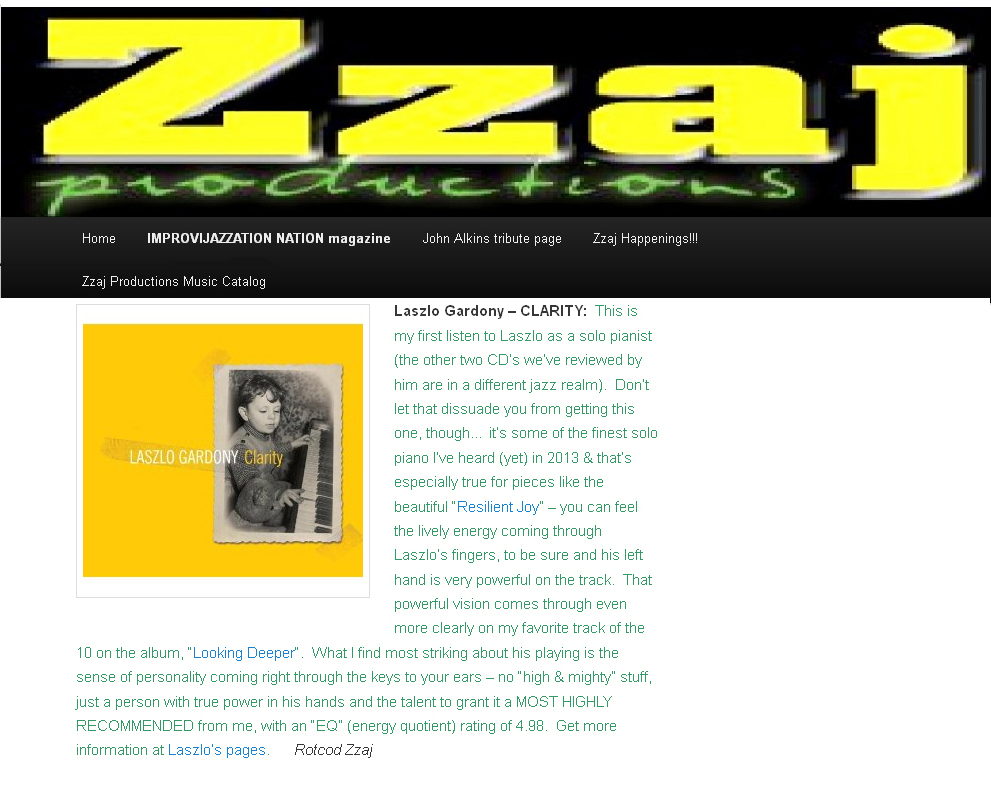
- BOB KARLOVITS All 9 cuts (except Gershwin's "Summertime") are highly creative originals from Laszlo... the keyword here is creative... not "wacked" (at all), just the ability to take a line & infuse it with significance that other players miss. Even gospel is not sacrosanct in his hands... as I sit here listening to the opener, " In Transit", I can't help but be reminded of "Universal Prisoner" on "Second Movement" by Les McCann/Eddie Harris... no, it's not an exact match (or a rip-off), but it's clearly in the same timeless realm... absolutely my favorite tune on the album, though " Heavy" runs a pretty close second. His treatment of Gershwin's tune would have (I suspect) brought a distinct smile to Ira's mug... great stride left hand that actually (believe it or not) makes the tune quite danceable. It's clear that the rest of the trio (bassist Joe Lockwood & drummer Yoron Israel) "get it" regarding Gardony's musical humor. This is, without question, the most "different" version of "Summertime" I've ever heard... nuthin' but FUN! I do think it would be nice to hear some reeds against tunes like this - maybe next time, eh? For those inclined towards jazz that features power piano, this comes MOST HIGHLY RECOMMENDED. Hands down, the "PICK" of the YEAR for "best piano trio". - DICK METCALF AKA ROTCOD ZZAJ It’s one thing to say you were influenced by… but to actually work with Dave Holland, Fathead Newman, John Abercrombie, Randy Brecker and many more gives it a new level of veracity. Gardony has moved into the realm of the greats he has aspired to with this driving set that finds him taking off the gloves and giving the classic jazz piano trio a run for it’s money. A piano man for these times, he marries the future with tradition and sprinkles his own flavor on the proceedings for a killer set that’s sure to impress. This is the place to stop for genre fans looking for something new to blow their ears wide open. Laszlo Gardony, born in Hungary but now a resident of Boston and a professor at Berklee, is the kind of outstanding, bread-and-butter jazz pianist we need more of. Dig Deep, featuring his longstanding trio including John Lockwood on bass and Yoron Israel on drums, demonstrates not a talented local cat playing bop and Bill Evans but much more. Eight of the nine tunes here are original, and even the Gershwin warhorse Summertime is entirely remade as a gospel song with shifting time signatures. The originals exhibit the same fun sense of explorationthey are typically based about a strong vamp or a killer bass line, and they use the groove of popular music as often as they sound specifically like jazz. But this is the jazz, with expressive improvisations emerging from the grooves and the sense of communication between the members of the group paramount. This is music made with an awareness of soul and rock, swing and gospel, but it is still made in the tradition of the great jazz trios. Gardony sounds less like Bill Evans or Bobby Timmons or Horace Silver than he does like an amalgam of Jarrett and maybe Cedar Waltona modern jazz pianist whose playing is pianistic and carefully arranged. Gardony does not try to dazzle you with speed or volume, but his group simply delivers the pleasure of its own united front on attractive, catchy themes. Which is more than enough. Rating: 7 out of 10 – WILL LAYMAN This CD is full of original compositions, save for one tune that is a Gershwin standard. It's a heartfelt record that sounds big; it has the feel of a live album, even though it isn't. Laszlo Gardony is a Hungarian born jazz pianist, schooled not only in jazz but rock, blues and classical. It's the tapestry of all those styles that makes this CD burst from its packaging. Gardony plays piano on Dig Deep and is accompanied by John Lockwood on bass and Yoron Israel on drums. The trio has been playing together for six years and create some intricate songs. Strengths: Gardony's piano is distinct; it has its own voice and tone and he plays it nimbly. New Song, for example, shows the expressive piano it sounds like a rainy weekend afternoon; the piano notes patter and the drummer makes his cymbal's splash. Wide Awake has the feel of an old 80s rock ballad, only without the pomp and circumstance. Gardony writes that he finds a lot of joy in marrying odd-meters/changing time signatures with the sound and groove of gospel, funk, jazz and rock. Lockwood and Israel help him create those odd time signatures. Heavy is another rock-infused tune with some crisp and brisk drumming. Israel plays complicated patterns on his snare/hi-hat and it's just a joy to hear. The drums take over Heavy, making it my favorite track. Listen for his rolls throughout the record. Weaknesses: Despite the pristine musicianship, some tracks seem to be muddled. The best tracks are exciting and alive, but there are only a couple. Final Thought: The drumming is wonderful, the piano is distinct and the bass fills in all the gaps. An excellent trio with some thoughtful music. – GRAY HUNTER Laszlo Gardony Trio – “Natural Instinct” (Sunnyside 4003) Joined by drummer Yoron Israel and bassist John Lockwood, Hungarian-born pianist/composer Gardony performs original compositions and arrangements on this intimate, jazz piano trio album. If jazz piano recordings make your world go around, this will be spinning in your player for quite some time. Gardony's resume precedes him: He's Professor of Piano at Berklee College of Music, has released over a half dozen albums as a bandleader, and has performed in 22 countries. He's also won numerous awards and worked with Dave Liebman, John Abercrombie, David "Fathead" Newman, Freddie Hubbard, John Blake Jr., Joe Lovano, Randy Brecker and many others. The tight interplay amongst Gardony, Lockwood and Israel is impressive, and careful listening reveals numerous subtleties of rhythm and arrangement. There's hardly an iota of ”world music" here as most would understand that phrase, but it is a great American-derived jazz trio outing." - ROBERT KAYE Laszlo Gardony : Natural Instinct (Sunnyside) Hungarian by birth, Gardony is a distinctive improviser who infuses his post-bop pianistics with references to his Hungarian folk roots. A grad of Budapest's Bela Bartok Conservatory, he emigrated to the US four years later to study at Berklee, where he is now a faculty member mentoring the most promising students. Bassist John Lockwood and drummer Yoron Israel - who add to the manifold delights of Laszlo's most recent Sunnyside CD, Natural Instinct - will also play with him. While the album may remind some of Keith Jarrett's output, it's full of deft percussive touches and an abiding romanticism that marks Gardony an original - PAUL BLAIR Modern plugged-in jazz is beginning to resemble a research lab. Those kinds of innovations are appreciated and to be encouraged, of course. All the same, it’s nice to know that folks like Laszlo Gardony are keeping alive the (very) smart and (very) soulful acoustic piano trio tradition. Gardony lies somewhere between the pianists (Monk, Andrew Hill) who seem to struggle against the instrument and those (Cole, Jarrett) whose musical ideas seem to flow unimpeded through the instrument. Like the latter group, Gardony's virtuosity is often unobtrusive, because his skill makes it sound easy; but like the latter group, he is capable of flights of arpeggiated fancy that seem to test the response time of the little-felt hammers inside the piano. Part of the enjoyment of listening to jazz piano has always been listening to the struggle of the first group, but another part is marvelling at the easy mastery of the second. On Natural Instinct, Gardony forges a middle path, combining the best of both schools. The record’s strong suit is surely the music’s rhythmic complexity: the tension between the melodic line and drummer Yoron Israel’s rhythm on the title track and “Waking Dreams” (a composition which channels the spirit of Herbie Nichols, another “middle path” pianist); or Gardony's soloing over the gentle bossa nova pulse underlying “Thinking of Stella” and “Someone.” Then again, another strength is the uniformly high quality of the compositions, a combination of pieces by Gardony and genuinely novel renditions of “Motherless Child” and Horace Silver’s “Peace.” And the record’s triumph may be the pianist’s harmonic complexity--he re-chords a passage of “Softly (As in a Morning Sunrise)” with just the same understated melancholy you might expect from Bill Evans. If Natural Instinct is immediately appealing, it also continues to reveal its subtleties over time. – JEFF DAYTON-JOHNSON The Boston-based pianist Laszlo Gardony’s music is as much about the song as the solo. At the Regattabar two weeks ago Wednesday, his long-time trio (with bassist John Lockwood and drummer Yoron Israel ) began with the title cut from their new CD, Natural Instinct (Sunnyside). The focus here was on Gardony’s riffy tune and the Afro-Latin beat. Gardony knows how to play fast Bud Powell–like single-note runs — as he did with his encore of Oscar Hammerstein & Sigmund Romberg’s “Softly, As in a Morning Sunrise” — but here and elsewhere he emphasized melodic variation, touch and tone, and rhythmic chording that kept the band, and the audience, moving all night. Sometimes that chording relied too much on blues-riffing arpeggios, but Gardony and his band know how to build a performance, and the momentum of the alternating 3/4 and 4/4 meter and his digging into those chords got the crowd cheering on the second tune, “Revolution.” When he writes a folk-pop tune like “Me and My Echo” it calls out for lyrics. For the original “Mockingbird,” he spun melody after melody out of his right hand while his left cycled gently through a Latin-flavored vamp. – JON GARELICK Every working jazz unit has a natural lifespan, often very long, and Gardony, bassist John Lockwood and drummer Yoron Israel are in the prime of their lifetime together. Whether playing originals or transformed standards, listening and interacting grows deeper among the three, and the overused term "seamless" picks up every stitch in this case. One of Boston 's finest groups – MILO MILES Laszlo Gardony Trio – “Natural Instinct “ (Sunnyside 4003) There seem to be an infinite number of jazz musicians who deserve to be better known than they are and pianist Laszlo Gardony is one of them. Natural Instinct shows why. Instead of being one of the legion of pianists who follow the style of Bill Evans, Gardony has a restlessness and hard rhythmic drive to his playing. You hear that in the subtle Latin groove of “Natural Instinct” and the bluesy waltz melody of “Motherless Child.” Even the man’s ballads like “Hidden Message” and “Someone” move with purpose. John Lockwood and Yoron Israel make a real trio recording out of this session, not only giving Gardony support but playing around with meter and time to make the performances more complex than they sound on the surface, particularly on “Waking Dreams” and “Thinking Of Stella,” a lovely variation on “Stella By Starlight.” Gardony goes it solo on Horace Silver’s “Peace” and keeps his lively style going even as he keeps the tune’s serene mood intact. Gardony is a very talented pianist who definitely deserves more recognition. – JEROME WILSON Pianist Laszlo Gardony can blister his way across a keyboard or ease through melodies with precision, and he does both of these often on the trio date Natural Instinct (Sunnyside). While drummer Yoron Israel serves as the rhythm aggressor and bassist John Lockwood the counter puncher, Gardony crafts, paces and executes tight, energetic solos or more lyrical, sentimental responses on such cuts as “Revolution,” “Me and My Echo,” “Softly (As In A Morning Sunrise)” and “Us and the Night and the Music.” Gardony and comrades are fine interpreters and players, and the trio sometimes play so smoothly it seems less a piano/bass/drums date and more a collective presentation. - RON WYNN Laszlo Gardony, a lyrical pianist, often shades his playing in pastels as he explores the standards and original material on Natural Instinct. For this effort he works in a compact trio with drummer Yoron Israel and bassist John Lockwood. Gardony’s laid-back approach works well most of the time. He has a bent towards building motifs with deliberation, layer upon layer, until he fulfills his vision. However, he makes a greater impact when he lets fire stoke his engines and sends him chugging along. The effect then is deep and intense. Gardony’s composition “Revolution” is based on a folk melody. Gardony extends the body of the melody with a meditative air, nestling a short burst of lilt against a sombre air. He swings with ease, with the rhythm section playing along. The duality of approach works well. Another original, “Thinking of Stella,” is a ballad, shimmering softly in the shade of the piano’s gentle ministrations. Gardony loosens up for “Motherless Child.” There is an emphatic spark as he thrusts forward and invests a host of colours, including a tint of the blues. Horace Silver’s “Peace” is the perfect vehicle for Gardony. He shades the tempo with a flow of germane ideas, letting space breathe life and then indulging in a whirlpool of notes, the alternating rhythmic shifts once again showcasing the sphere of his improvisation. Gardony, Lockwood and Israel play with insight and assurance, whatever the mood, helping make this recording accessible and pleasing. – JERRY D’SOUZA HOME • DISCOGRAPHY • MUSIC • REVIEWS • VIDEO • |
 JAZZ TIMES, October 2011
  HARTFORD COURANT, August 25th, 2011
  ALL ABOUT JAZZ, June 30th, 2011
  BOSTON PHOENIX, October 25th, 2011
  JAZZ MUSIC, June 18th, 2011
  BUFFALO NEWS,



 September 7, 2008
 JAZZ 100, AUSTRALIA June, 2008
 HAWAII May 2008
  San Carlos , CA May 31, 2008
 May 19, 2008
 August 25, 2008
 August 16, 2008
 GLOBAL RHYTHM MAGAZINE November 2006
 ALL ABOUT JAZZ August 2006
  THE PHOENIX July, 2006
  WBUR.ORG May/June 2006
  CADENCE MAGAZINE December 2006
  NASHVILLE CITY PAPER, July 14, 2006
  THE IRISH TIMES August 11, 2006
  ALL ABOUT JAZZ July 23, 2006
  JAZZTIMES, September 2003
 BOSTON GLOBE, June 13, 2003
 THE BOSTON PHOENIX, January 24-31, 2002
 THE IRISH TIMES
 ALL ABOUT JAZZ.COM IAJE CONFERENCE CONCERT REVIEW
 THE BOSTON HERALD, September 16, 2001
 THE BOSTON TAB
 CADENCE, September 2001